The faithful penny has been around since 1793 and has been a staple of U.S. Currency since. While inflation has changed the price of items, the penny has always had its value as the little guy that offers buyers exact change that could then be used for their next purchase; that was until recently. As of November 12th, 2025 pennies are no longer being pressed and sent out to the masses but why should people care? Barely anybody uses physical currency, it’s all cards and phones nowadays, what’s a little copper coin worth to us anyway? Well it could potentially be costing consumers $6.06 million dollars yearly!
According to the U.S. Department Of The Treasury (USDT) the cost to produce a penny has increased from 1.3 cents to 3.69 over the past ten years. The end of production is projected to save approximately $56 million from no longer needing the materials to produce pennies. The change to stop production of pennies has been encouraged by consumers switching to digital payment methods for their daily needs. The USDT states that there are approximately 114 billion pennies in rotation so the public and Point-Of-Sale system providers shall adapt to the change eventually resulting in a sales tax no longer rounding to the nearest penny but rather the nearest ¢5. So how would that affect consumers’ everyday purchases?
Using data from 2024 Diary of Consumer Payment Choice (DCPC) the Richmond Federal Reserve Bank (FRBR) has created a chart predicting how rounding tax would affect consumers. Rounding tax occurs when goods are taxed and the total would be rounded to the nearest cent. For example California’s base tax is %7.25 so if someone bought a soda for $1.25 the tax would bring the total to $1.340625 which would then be rounded down to a flat $1.34. Presuming that the penny is no longer used, goods would instead be rounded up or down to the nearest five cent interval, increasing the cost of that soda by one cent. Astute readers may realize that their goods total can also be rounded down reducing the total cost but as can be seen in the chart below such a scenario is more unlikely.
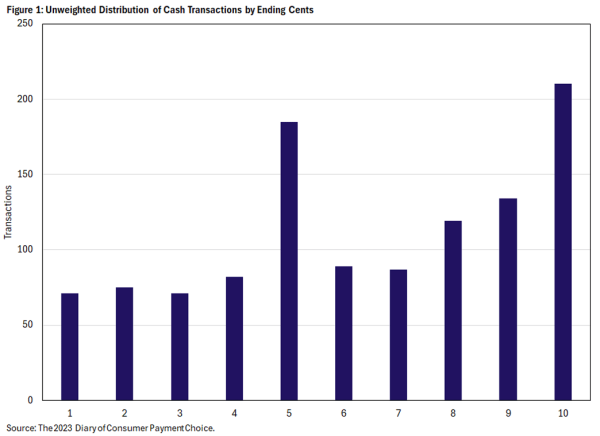
Data taken from DCPC showing cash transactions ending with cents.
FRBR’s economic brief title, Rounding Up: The Impact of Phasing Out the Penny states, “Based on this sample, we estimate the overall impact of rounding… We estimate that rounding to the nearest nickel would cost consumers about $6.06 million annually, assuming transaction patterns remain unchanged.” While it may be small that amount does add up especially for students purchasing discounted food at COS leading to students possibly paying a burrito or sandwich’s worth of rounding tax. So what were some of the students thoughts when asked, “Do you typically use cash or card for purchases and how do you feel about the penny being phased out?”
Arturo Figueroa, History Social Science Department Chair
“I use card way too much, more than I should and I rely too much on digital money more than cash. I feel that I don’t have much control with my finances and would do better budgeting with cash. It’s nostalgic. I wonder how the transition will happen and how people will adjust. Curious about the value for collectors.”
Joshua Curtiss, Teacher on Special Assignment
“I almost entirely use card for purchases and I feel kinda mixed emotions about the penny being phased out because of nostalgia because I can see if the penny costs more than it’s worth. My logical brain thinks it’s a wise idea to phase out the penny.”
Jasmine Ortiz, Student
“As a student I use cash mostly, I don’t have a particular feeling about it. Just how we’re going to go about it”
Stella Navarro, Student
“I use card. Obviously one penny on its own isn’t worth much but when you collect a 100 it’s worth a dollar. You have to look at the bigger picture cause when you add it all up it makes a huge difference.”
Luze Aragon, Student
“Well I use card payments and about the penny I’m not really sure, I haven’t heard a lot about it”
Delilah Padilla, Student
“I use on a day to day basis card more, I quite like the penny, I haven’t use it a lot though when buying food but I think it helps people who use cash so I think the penny should have stayed.”
Catherine Weigel, Student
“I mostly use card and the penny, I really don’t care but I have seen multiple people that pay with cash but can’t get exact change because theres a penny shortage.”
Amelia Hernandez, Student
“I use cash more, I think I like it but I don’t really use change that much I say keep the coins, I don’t really keep coins.”
Ren Wang, Student
“I usually use card and the penny being phased out, I feel like it’s important to get exact change because it does add up and I don’t really feel like there’s a need for it. It’s a bit concerning getting rid of a currency that’s been there for a bit and could cause issues in the future with inflation for those that depend on it.”
With mixed responses it’s hard to say if this change is considered good or bad. America is amongst one of the three other countries that have phased out smaller currencies, Australia discontinued its 1-cent and 2-cent coins in 1992, New Zealand eliminated its 1-cent and 2-cent coins in 1990 and its 5-cent coin in 2006, and Canada ceased penny production in 2012. Maybe the government can take note of how their economy has changed over the years to predict how our use of money might change. For those that still have pennies lost in their wallets, pants, or drawers; note that any minted in 2025 may be the last pennies created.