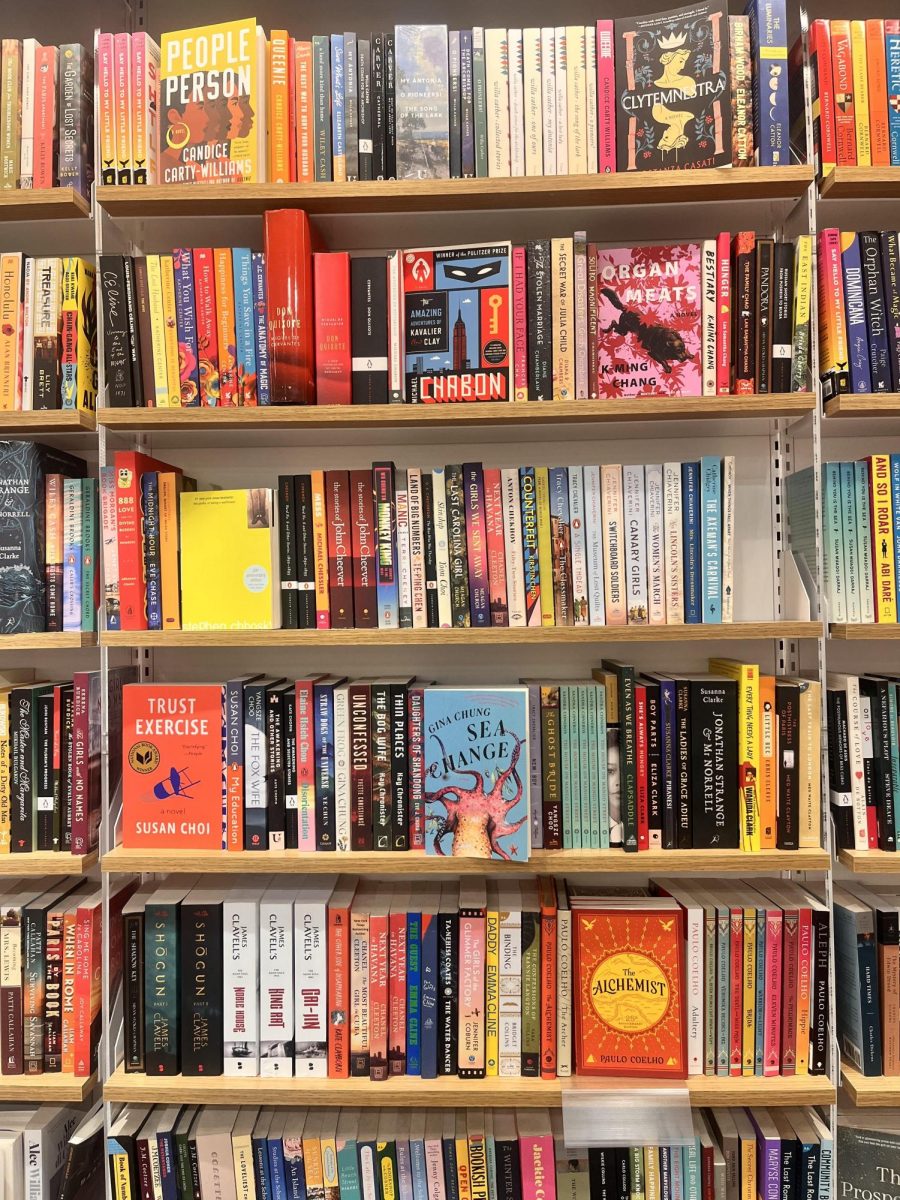
Reading is an essential tool that everyone needs to use throughout their lives. From the mundane translating of street signs or cooking instructions to understanding the deeper themes of a film or the subtle suggestions in a message; Reading comprehension is essential to understanding others from the words they’re spewing or the texts they’re consuming. Aside from obvious informational books students are reading for classes or their interests, reading provides an entertaining way to expand a person’s vocabulary and indulge their imagination. In order to avoid literary FOMO, here’s what’s most popular on campus.
As of March 30th a total of 2,319 books have been checked out from the COS Library. Of those 2,319 books, 1,438 are course related while 881 are non-course related otherwise known as recreational. The top four course books checked out were,
- “Voices of Freedom : A Documentary History” by Eric Foner
- “Calculus : Early Transcendentals” by James Stewart
- “Human Anatomy” by Frederic H Martini, Robert B. Tallitsch, and Judi L. Nath
- “Welding : Principles and Applications”
Based on this list it can be inferred that there’s a predominant number of students that are majoring in these subjects or require them to obtain their desired major. Expect to see a lot of political scientists, fluent in calculus and human anatomy, taking on welding jobs in the future. Seriously though, the books here show that students are looking to be educated about the country’s history and how its definition of freedom has evolved. Peers desire deeper understandings of complex equations that could help them further careers in tech, science, finances, and whatever else requires indulging in complex mathematics. Lastly, students are looking into sustainable blue collar jobs that will always be in demand ensuring their skills are always in demand.
Below are the non-course related books checked out from the library and their blurbs taken from Goodreads,
- “The Maze Runner” by James Dashner
- If you ain’t scared, you ain’t human.
When Thomas wakes up in the lift, the only thing he can remember is his name. He’s surrounded by strangers—boys whose memories are also gone.
Nice to meet ya, shank. Welcome to the Glade.
Outside the towering stone walls that surround the Glade is a limitless, ever-changing maze. It’s the only way out—and no one’s ever made it through alive.
Everything is going to change.
Then a girl arrives. The first girl ever. And the message she delivers is terrifying.
Remember. Survive. Run.
- “We Are Little Feminists: Hair” by Brook Sitgraves Turner and Archaa Shrivastav
- Beautiful photos of real-life families showcase all the wonderful forms of hair, while poetic text builds both vocabulary and family connection. HAIR helps families and educators celebrate race and ethnicity at home and in the classroom.
Created with 0-5-year-olds in mind.
Part of We Are Little Feminists – the board book series made for raising intersectional feminists.
- “1984” by George Orwell
- A masterpiece of rebellion and imprisonment where war is peace, freedom is slavery and Big Brother is watching. Thought Police, Big Brother, Orwellian – these words have entered our vocabulary because of George Orwell’s classic dystopian novel “1984.” The story of one man’s Nightmare Odyssey as he pursues a forbidden love affair through a world ruled by warring states and a power structure that controls not only information but also individual thought and memory 1984 is a prophetic haunting tale More relevant than ever before 1984 exposes the worst crimes imaginable the destruction of truth freedom and individuality.
- “Little Fires Everywhere” by Celeste Ng
- Everyone in Shaker Heights was talking about it that summer: how Isabelle, the last of the Richardson children, had finally gone around the bend and burned the house down.
In Shaker Heights, a placid, progressive suburb of Cleveland, everything is meticulously planned – from the layout of the winding roads, to the colours of the houses, to the successful lives its residents will go on to lead. And no one embodies this spirit more than Elena Richardson, whose guiding principle is playing by the rules.
Enter Mia Warren – an enigmatic artist and single mother – who arrives in this idyllic bubble with her teenage daughter Pearl, and rents a house from the Richardsons. Soon Mia and Pearl become more than just tenants: all four Richardson children are drawn to the mother–daughter pair. But Mia carries with her a mysterious past, and a disregard for the rules that threatens to upend this carefully ordered community.
When old family friends attempt to adopt a Chinese-American baby, a custody battle erupts that dramatically divides the town – and puts Mia and Elena on opposing sides. Suspicious of Mia and her motives, Elena is determined to uncover the secrets in Mia’s past. But her obsession will come at an unexpected and devastating cost . . .
- “I Am Not Your Perfect Mexican Daughter” by Erika L. Sánchez
- Perfect Mexican daughters do not go away to college. And they do not move out of their parents’ house after high school graduation. Perfect Mexican daughters never abandon their family.
But Julia is not your perfect Mexican daughter. That was Olga’s role.
Then a tragic accident on the busiest street in Chicago leaves Olga dead and Julia left behind to reassemble the shattered pieces of her family. And no one seems to acknowledge that Julia is broken, too. Instead, her mother seems to channel her grief into pointing out every possible way Julia has failed.
But it’s not long before Julia discovers that Olga might not have been as perfect as everyone thought. With the help of her best friend Lorena, and her first kiss, first love, first everything boyfriend Connor, Julia is determined to find out. Was Olga really what she seemed? Or was there more to her sister’s story? And either way, how can Julia even attempt to live up to a seemingly impossible ideal?
For those who are interested in procuring some reading material from the COS library the process is quite simple. Choose a book from the selection available on the first or second floor and bring it to checkout. Provide a banner ID or name and birthday to keep a book for a three week period. Sometimes the library does not have the book physically but keeps it stocked digitally in which they will send an email for access to the book for a similar three week period.
For those that have trouble knowing where to start or need more encouragement to pick up a book consider reading Clare Carlson’s article The dreaded book slump: ways to start reading for more information about the recent decline in literary interest and how to reignite the passion.